Unlike most commentary on AI search, which tends toward vague predictions or new acronyms (GEO, AEO, AIO, SEO for AI, etc etc), a recent article on the Bing Search blog offers something rare: a clear and honest explanation of what is happening inside AI search engines.
The post was published in May 2026 by three engineers at Microsoft AI. Here is what I took from it.
The index is the same but its goal has changed
When a search engine like Google or Bing crawls the web, it builds a giant catalogue of pages, recording what each page is about, how trustworthy it seems, and how it relates to other pages. That catalogue is called the index. Every time you type a search query, the search engine consults that index to decide what to show you.
This is a crucial point: the index is not new, and it is not being replaced. Both traditional search and AI search rely on the same underlying index, built by the same crawlers, evaluated with the same quality signals.
What has changed is the question the search engine is trying to answer.
Traditional search has always asked: which pages should a user visit?
AI-powered search asks: what information can be responsibly used to construct a response?
Those questions sound similar. They are not. With traditional search, the algorithms decided what was worth showing. Now they decide what is true enough to say. That is a very different responsibility, and it changes everything downstream, from how content is written to how quality is measured.
The search engine is now editorially accountable
In traditional search, ranking imperfections are tolerable. Results are optimised for likelihood of relevance, and the user carries out the editorial work: browsing, bouncing, reading, scanning, judging, comparing, skipping. The search engine is accountable for surfacing options. The user decides what to trust.
AI-powered search cannot hand that responsibility back to the user. When a model constructs an answer and presents it as fact, it is making an editorial judgement on your behalf. The system must now ask whether the evidence behind its answer was accurate, fresh, attributable, and consistent. And when the evidence is not good enough, the right answer is sometimes no answer at all. Choosing not to respond is a valid outcome, not a failure.
How AI search actually retrieves information: grounding and query fan-out
When you send a prompt to an AI search tool, the model does not automatically go and check the web. First, it makes a probabilistic judgement: does this question require real-time information, or can it be answered from what the model already learned during training?
That decision is made by the model itself, based on the nature of the prompt, and it is not guaranteed to go one way or the other.
Take two prompts: "when did Napoleon die?" and "which is the best [product category] in 2026?" The first is a historical fact that does not change. The model will almost certainly answer from its training data without checking the web. The second is time-sensitive and commercially loaded. The model will very likely decide it needs to verify against current sources before responding.
If the model decides it needs to check the web, it does not run a single search the way a person would. It generates a set of hidden sub-queries, each targeting a specific piece of information needed to construct the answer. This is called query fan-out. And it works in a loop: the model retrieves results, evaluates what it has, identifies what is still missing, and generates further queries to fill the gaps. A single user question can trigger a whole chain of searches that happen entirely behind the scenes.
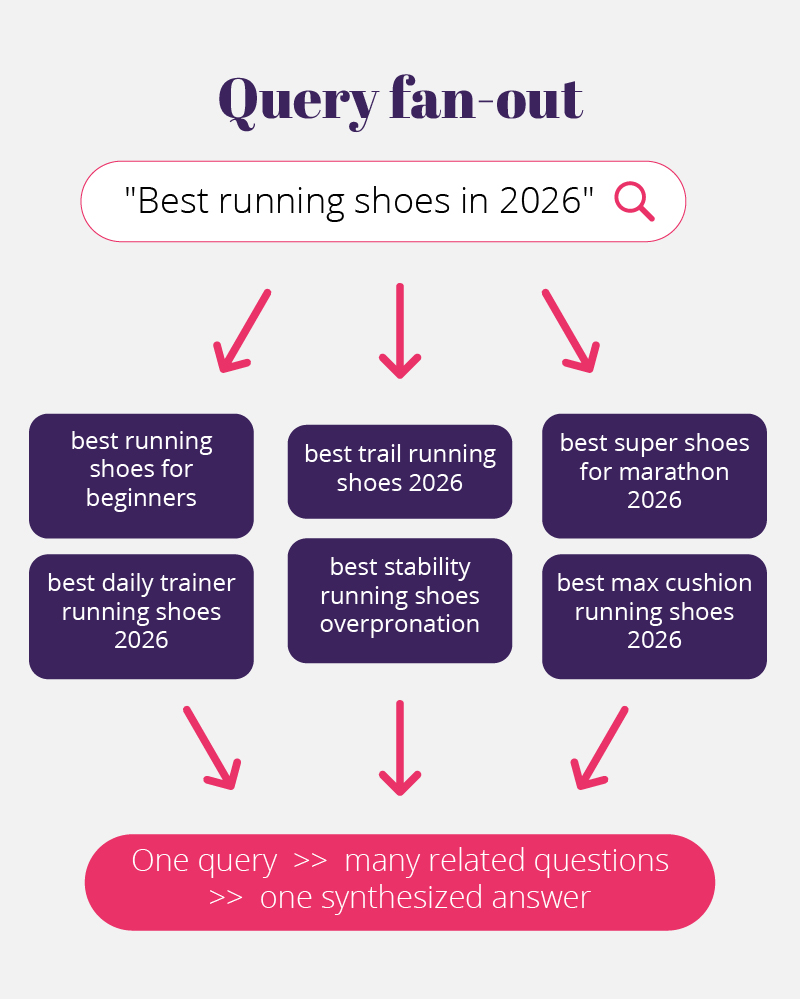
This process, anchoring an AI response to real, retrievable sources on the live web, is what is meant by grounding. And here is the part that matters for SEO: the infrastructure that makes grounding possible is still the same index used by traditional search tools. Grounding does not bypass traditional search infrastructure. It builds on top of it, adding one new question to the evaluation: is the information on this page reliable and attributable enough to use in a constructed answer?
For businesses, the implication is direct. A page that ranks well in traditional search and a page that gets used by an AI to construct an answer are not automatically the same thing.
What has not changed, and what is becoming more important
The technical foundations of good SEO remain intact, and actually they are becoming more important. A well structured website, clear and accurate content, information that is easy to scan, data that is easy to retrieve, a credible and authoritative online presence: these are exactly the signals that both traditional search and AI search use to evaluate pages. Google has been equally clear on this in its own official guidance. The index is shared, and the technical criteria that determine whether a page earns a place in that index have not fundamentally changed. What is changing is what happens after a page enters the index.
In traditional search, a page competes to be shown. In AI search, a page competes to be used.
That is a meaningful distinction. AI search does not reward pages that cover a topic broadly. It rewards pages that answer specific questions clearly, with information that is easy to verify and attribute to a credible source.
The shift, in practical terms, is from being found to being trusted.
What we do at Storm12
We help businesses navigate this shift practically. Alongside the SEO fundamentals that remain essential (site architecture, backlink profile, page speed, technical health) we are raising the bar on:
- Content credibility signals: writing style, authorship, certifications, third-party trust signals and cross-page consistency across facts and figures
- Content decay analysis and freshness planning
- Query fan-out mapping to anticipate the sub-queries AI systems generate for your industry and products
- AI search source monitoring and citation tracking across AI-generated answers
- Crawl analysis with a focus on JavaScript rendering gaps that block AI systems from reading your content
- Schema markup integration to make page data machine-readable
- Semantic markup and content structuring so AI systems can parse and extract your content cleanly
None of this replaces the fundamentals. It sits on top of them.
If you want to understand how your website is currently positioned for AI search, get in touch.
- share
-

-

Back to Blogs